Surgery
ACL graft types: what the choice actually changes
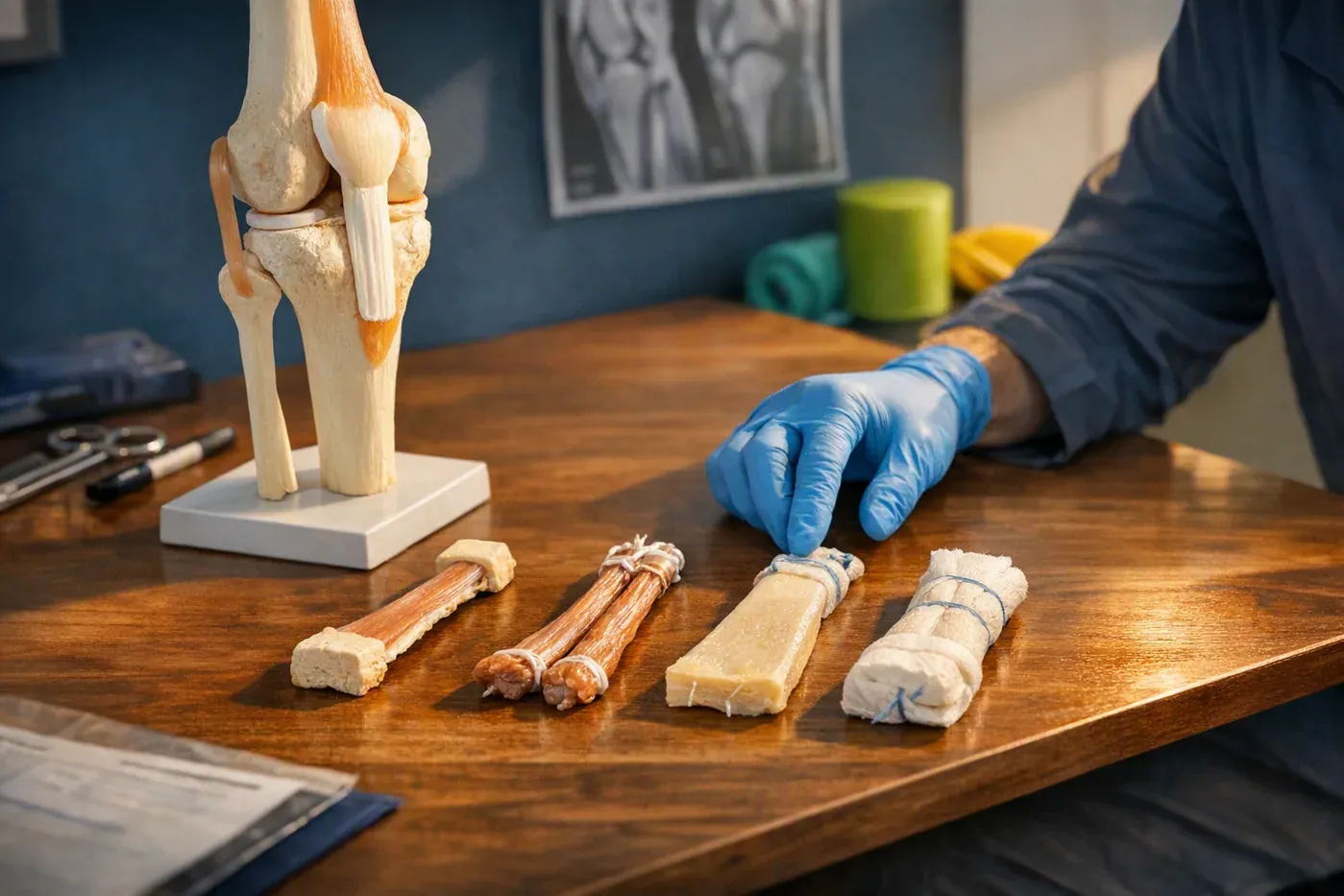
Patellar tendon, hamstring, quadriceps tendon, allograft. What each one costs you in the short term, what the failure data says, and the one figure that should settle the question for anyone under 25.
Graft choice is your surgeon's decision, made with you, and it is worth arriving informed rather than with a preference borrowed from a message board. The four options in routine American practice differ less in how well they work and more in what they cost you on the way there, with one exception where the outcome data is not close.
The four options
| Graft | Taken from | Short-term cost to you | Notes |
|---|---|---|---|
| Bone-patellar tendon-bone (BTB) | The middle third of your own patellar tendon with bone plugs | Anterior knee pain, kneeling discomfort that can persist | Long the reference for high-demand athletes, bone-to-bone healing |
| Hamstring autograft | Your own semitendinosus, sometimes with gracilis | Slower hamstring strength recovery, hamstring soreness early | Less front-of-knee pain, and the H:Q ratio becomes something to watch |
| Quadriceps tendon autograft | The upper part of your own quadriceps tendon | Quadriceps soreness and a slower early quad curve | Increasingly used, avoids hamstring harvest and patellar tendon harvest |
| Allograft | Donor tissue | No harvest site, so the easiest early recovery | The failure data in young athletes is the problem, see below |
The allograft figure for young athletes
In the MOON prospective multicenter cohort, the odds of graft rupture with an allograft were 4 times those of an autograft, and for each 10-year decrease in age the odds of rupture rose 2.3 times, with patients aged 10 to 19 showing the highest percentage of graft failures. Those two effects multiply in exactly the population most likely to be offered an allograft because it means an easier early recovery.
What graft choice does not change
The phases of rehab, the criteria that gate them, the nine-month conversation, and the fact that your quadriceps has to be measured. Every graft goes through the same gates. The difference is which part of the leg complains while you do it.
What it does change in your rehab
- Hamstring autograft: hamstring strength lags, and a lower hamstring to quadriceps ratio at 60 degrees per second was associated with graft rupture in a cohort of 158 professional athletes, with a hazard ratio of 10.6 per 10% difference. Hamstring work is not optional with this graft.
- Patellar tendon autograft: expect anterior knee pain to shape the early quadriceps progression, and expect kneeling to stay unpleasant for a while.
- Quadriceps tendon autograft: the early quadriceps curve is slower because the muscle the graft came from is the one you are trying to wake up.
- Allograft: the early recovery feels easier, which is precisely the trap. The graft incorporates on a different, generally slower biological timeline, and the temptation to return early is stronger because nothing hurts.
Age is the variable that dominates
Whatever the graft, the age numbers are the ones that should shape the plan. Graft ruptures occurred in 18% of 316 patients in one series, with the highest rate, 28.3%, in males under 18, and 47% of ruptures happening in the first postoperative year. In a meta-analysis of 19 studies, second ACL injury reached 23% in athletes under 25 who returned to sport. A 17-year-old and a 40-year-old having the same operation are not running the same risk, and the runway before return should not be the same either.
Questions worth asking your surgeon
- Which graft do you recommend for me specifically, and what about my case drives that?
- How many of these do you do a year, and what is your usual rehab timeline for this graft?
- If an allograft is proposed and I am under 25, what makes it the right call here?
- Will anything else be repaired at the same time, and how does that change my restrictions?
- What weight-bearing and range-of-motion restrictions will I have, in writing, for my physical therapist?
- Are you and the facility in network for my plan, and is the anesthesiologist?