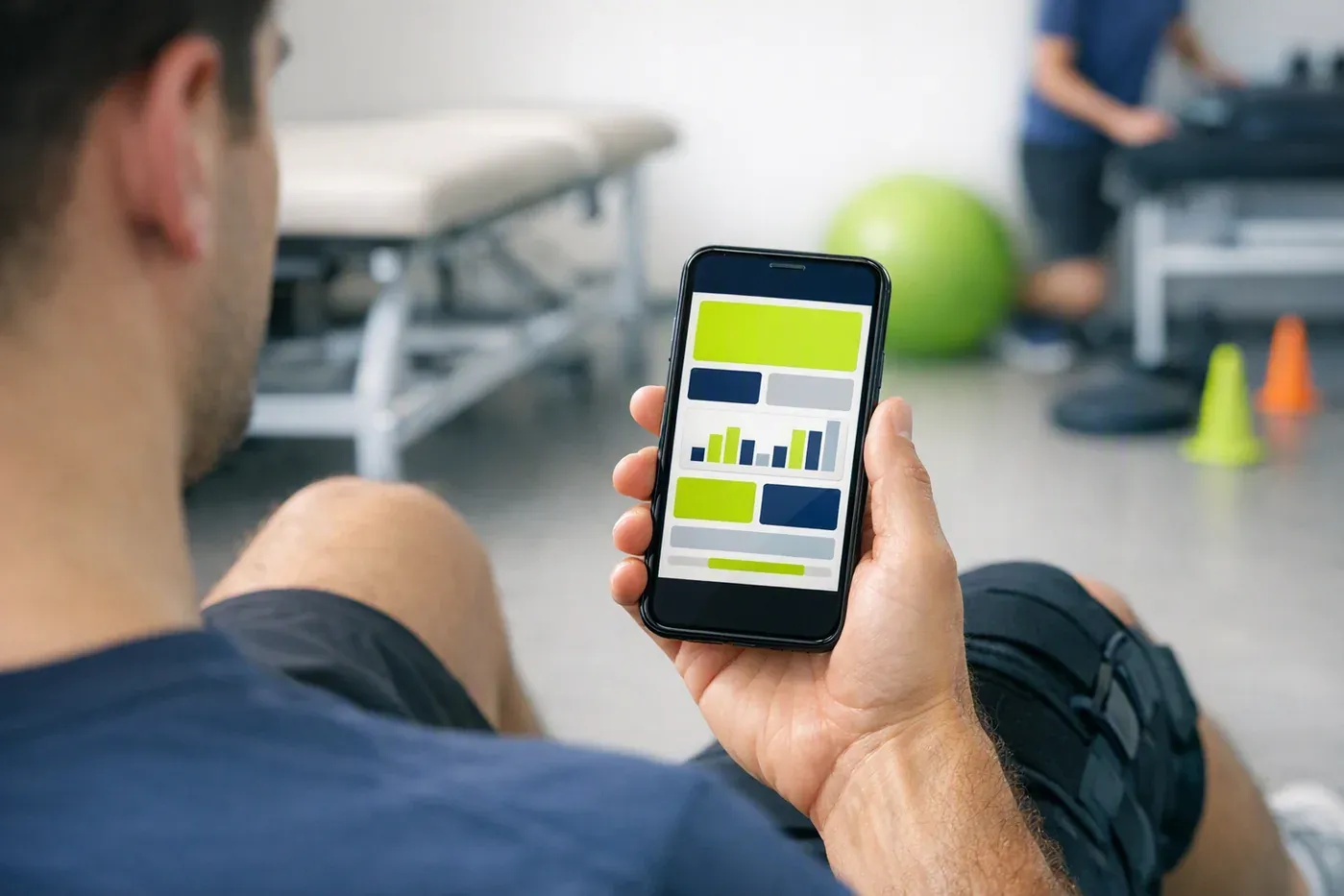
The app
What the app does, screen by screen
ACL recovery runs twelve to eighteen months and turns on numbers that end up scattered across a notebook, a camera roll and whatever you can remember of last week's session. Here is what the app holds for you, feature by feature, with the exact figures behind each screen.
The short version
- Six phases and nineteen exit criteria: the next phase opens on measurements you have hit, not on a date.
- Fifty-six guided movements, each with its execution cue and the mistakes people actually make.
- Ten measurable quantities, including the limb symmetry index between the operated and healthy side, computed for you.
- Seven questionnaires used in clinical research, including the ACL-RSI that scores confidence about returning to sport.
- A printable summary for your appointment, and an access link you open and revoke yourself.
The road map: six phases, nineteen criteria
The home screen shows one thing: the phase you are in, and how many criteria you have already met out of that phase's total. The next phase is offered when the measured criteria are met, then confirmed with your clinician. The week windows stay indicative and never trigger a transition on their own: they exist to remind you what biology still forbids even when your numbers look good.
| Phase | What it works on | Indicative window | Criteria |
|---|---|---|---|
| 1. Protection and recovery | Settle the swelling, get extension back, wake the quadriceps | Weeks 0 to 2 | 3 |
| 2. Range and muscle activation | Recover flexion, rebuild gently | Weeks 2 to 6 | 4 |
| 3. Strength and control | Build strength and neuromuscular control | Weeks 6 to 16 | 4 |
| 4. Running and plyometrics | Run in a straight line, land under control | Weeks 16 to 26 | 3 |
| 5. Cutting and reconditioning | Change of direction, sport-specific movement | Weeks 26 to 39 | 4 |
| 6. Return to sport | Full training, then competition | Weeks 39 to 52 | 1 |
Every criterion carries its numeric target and the measurement that feeds it. Phase 3 asks for full flexion at 130 degrees and a thigh girth back within 2 cm of the healthy side. Phase 4 asks for a quadriceps limb symmetry index of 80 percent and a single hop at 85 percent. Phase 5 asks for an ACL-RSI of 65 out of 100 and a hamstring to quadriceps ratio of 0.55. The last criterion, in phase 6, is your clinician's sign-off: the clearance decision belongs to your surgeon and your physical therapist, and the app hands them the numbers to make it on.
Why criteria beat a calendar
Two people operated on the same morning do not reach full flexion in the same week. A calendar-driven plan sends the first one running too early and holds the second one back too long. Showing what is missing, criterion by criterion, answers the only question that matters between two visits: what do I need to gain before the next one?
Today's session: fifty-six guided movements
The program serves today's session in order, with sets, reps and a built-in timer. Every movement in the library carries its execution cue and the mistakes that turn a useful exercise into a sore knee. Fifty-six movements cover the whole journey, from the ankle pumps of week one to the single-leg hops of the return phase, unlocking as the phases open.
Closing a session takes three answers: what you actually did, perceived effort from 0 to 10, and knee pain after the work. Those three numbers drive the following days. A declared rest day stays part of the program rather than a hole in the record. The session screen opens offline, because the gym in the basement has no signal.
Measurements: ten quantities and a plausibility check
Measurements are what move the criteria. The app tracks ten: flexion and extension in degrees, four girths in centimetres (10, 15 and 20 cm above the patella, plus patellar and calf circumference), body weight, single-leg stance time, and the stroke test graded 0 to 3 for effusion.
Every quantity is bounded. A value outside physiological bounds is refused, and too large a jump from the previous entry asks for explicit confirmation before it is stored: four centimetres of thigh girth gained in a week is almost always a tape measure in the wrong place. The operated side is always entered alongside the healthy side in the same sitting, because the comparison is what carries meaning. The limb symmetry index between the two is computed automatically and feeds the strength criteria of phases 3 to 5 directly.
Field and laboratory testing
Hop tests are entered leg by leg: single hop, triple hop, crossover hop and the timed six-metre hop. Isokinetic results from a testing centre sit in the same place as everything else, as peak torque for quadriceps and hamstrings, which feeds the hamstring to quadriceps ratio. Isometric values and single-leg stance time complete the set. Everything keeps its date, because a trajectory is what counts and an isolated value says nothing about one.
Seven validated questionnaires
Knee numbers do not say everything. The app includes seven instruments used in clinical research and in clinic:
- SANE, the single assessment numeric evaluation: where is your knee today, from 0 to 100 percent of a normal knee.
- KOOS, covering pain, symptoms, daily activities and quality of life.
- ACL-RSI, confidence about returning to sport, which is also a phase 5 exit criterion.
- IKDC subjective, the reference functional score after reconstruction.
- Lysholm, everyday interference: giving way, locking, stairs.
- Tegner, activity level, before the injury and today.
- PHQ-2, two questions on mood: a long rehab weighs on people, and that weight is measurable.
Photographs, with the previous one as an overlay
Scar, knee from the front, knee from the side. When you take the photo, the previous one appears as a pale overlay and you line the knee up on it. Without that identical framing, two photos do not compare and the series means nothing. Images stay in your account and go nowhere until you share something.
The summary you take to your appointment
The summary is generated right before the visit and takes the day's numbers: current phase, criteria met and missing, latest measurements on both sides, symmetry indices, tests, questionnaire scores and recent adherence. Print it or share it as a link. You decide what that link shows, and it stops when you say so. The fifteen minutes of appointment time then start on data instead of an effort of memory.
Your care team
You invite your physical therapist, your surgeon or your sports medicine physician with a time-limited code you generate. Each access shows exactly what that person can see and is revoked in one tap. Until someone is invited, nobody has access to your data. Your clinician sees your numbers between visits instead of asking you to reconstruct them at the start of the next one.
The return to sport grid: eight criteria
Return to sport has its own grid, separate from the phase criteria: no effusion, full extension, symmetric flexion, quadriceps and hamstring limb symmetry index at 90 percent, hamstring to quadriceps ratio at 0.55, hop test battery at 90 percent and an ACL-RSI of 65 out of 100. Eight lines, ticked or not, with what is missing spelled out. This is the page to put on the desk the day clearance comes up.
Your data stays yours
The app installs on the phone like a native app and works offline: entries made without a signal sync when the connection returns. Everything in your account exports as JSON, measurements, tests, questionnaires, sessions and documents included. Deleting the account erases all of it.