Strength
Quadriceps strength after ACL surgery
The most predictive number in the recovery and the one most often guessed. How it is measured, why it stays behind, what the thresholds are, and how a deficit shows up years later.
If you only track one thing after an ACL reconstruction, track this. The operated quadriceps loses strength faster than anything else in the leg, regains it slowest, and carries the deficit into movement patterns long after the knee feels normal. It is also the easiest thing in the whole recovery to be wrong about, because a leg that feels equal is routinely 15 to 25% behind.
Why the quadriceps shuts down
Three reasons stack up. Fluid in the joint reflexively inhibits the quadriceps, which is why effusion control is strength work rather than cosmetics. Pain and the surgical insult reduce voluntary drive, a phenomenon usually called arthrogenic muscle inhibition. And the leg is then used less for weeks, so the muscle itself gets smaller. Those three do not resolve at the same rate, which is why activation work and strength work are different jobs.
How it is actually measured
| Method | What it gives you | Where you find it |
|---|---|---|
| Isokinetic dynamometer | Peak torque at a set speed, the reference standard in the literature, expressed in newton-meters | Sports medicine centers, universities, larger clinics |
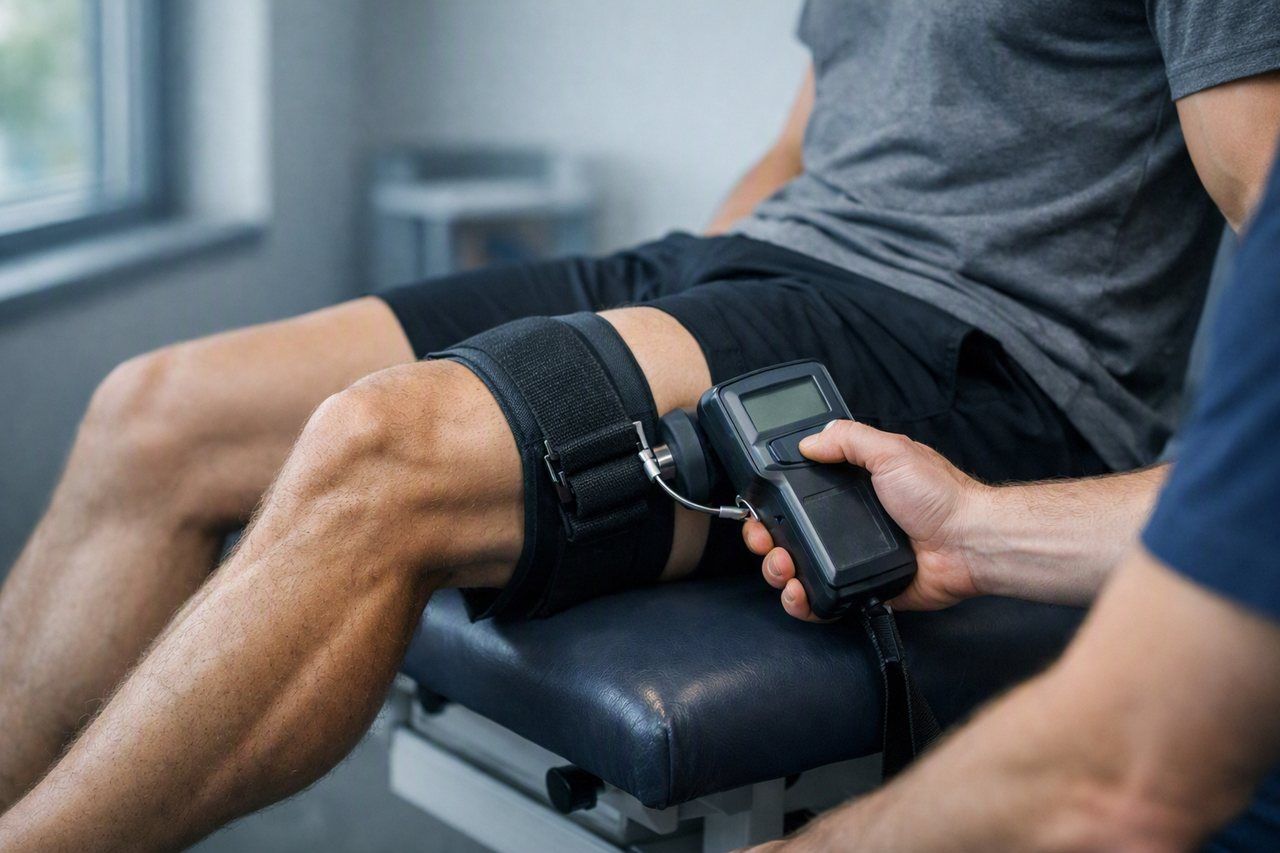
| Handheld dynamometer | Isometric force in pounds or kilograms, good repeatability when the tester is consistent | Most physical therapy clinics |
| One-rep max estimates on a leg press or extension | A usable proxy for tracking, contaminated by technique and by the other leg | Any gym |
| Single-leg tests | Function, not isolated strength. Easy to pass with compensation | Anywhere |
| Feel | Nothing. This is the entire problem | Everywhere |
The unit everything is expressed in
Limb symmetry index: operated leg divided by other leg, times 100. Most return criteria ask for 90% or better. Run your own numbers through the symmetry calculator.
What the deficit predicts
In the Delaware-Oslo cohort, more symmetrical quadriceps strength before return significantly reduced the reinjury rate. In 54 young athletes followed with landing mechanics, those who had quadriceps asymmetry at the time of return to sport were still unloading the operated leg two years later, visible in knee flexion excursion and peak vertical ground reaction force. The asymmetry does not simply fade with time and activity; it gets written into how you move.
It is worth being straight about the counter-evidence here too. In a Swedish registry cohort of 159 athletes, symmetrical quadriceps strength and muscle function at return were not associated with a second ACL injury, while returning before 9 months carried a hazard ratio of 6.7. Strength symmetry is a goal with good mechanistic and cohort support, not an outcome guarantee.
Typical trajectory, and where to worry
| Time point | Common symmetry range | Reading |
|---|---|---|
| Week 2 | 30 to 60% | Expected. The job is activation, not load. |
| Week 6 | 50 to 70% | Expected. Should be climbing steadily. |
| Week 12 | 60 to 80% | Below 60% here is a signal, not a personality trait. |
| Month 5 | 75 to 90% | This is the window where a stalled number needs a plan. |
| Month 9 | 90%+ is the target | Under 85% at nine months means the gap will be there at month eighteen unless something changes. |
What actually closes the gap
- Get the effusion out and keep it out. An inhibited quadriceps cannot be strengthened into symmetry.
- Load heavy, eventually. Three sets of fifteen on a light leg press builds endurance. Strength deficits need progressive heavy loading once your surgeon allows it.
- Train the muscle in isolation, not only in squats. A bilateral squat lets the strong leg do the work, invisibly. Single-leg and open-chain work, within the range your surgeon permits, is what forces the operated side.
- Measure monthly. A number that has not moved in six weeks is the only reliable signal that the program needs changing.
- Do not let the other leg deteriorate. If it loses strength during your recovery, your symmetry index improves while your leg gets no better. That is the arithmetic trap in every symmetry threshold.
Kneeling, and other graft-specific complaints
A patellar tendon autograft leaves many patients with anterior knee pain and a lasting dislike of kneeling on hard surfaces. A hamstring autograft leaves the hamstring behind instead, which matters because a lower hamstring to quadriceps ratio at 60 degrees per second was associated with graft rupture in the Kyritsis cohort, with a hazard ratio of 10.6 per 10% difference. Neither is a reason to change graft after the fact, and both are reasons the programs differ. See graft types.