Surgery
ACL reconstruction surgery, step by step
What happens on the day: the nerve block, the arthroscopy, the graft, the tunnels and the fixation. What the meniscus changes about your first six weeks, and what the operation does not do for you.
By the time a date is on the calendar, most of the decisions have already been made: whether to reconstruct at all, which graft, which surgeon and which facility. What is left is the day itself, and it is usually the part nobody has described to you in plain language. Here is what happens, in the order it happens, and what each step means for the twelve months that follow.
What the operation actually is
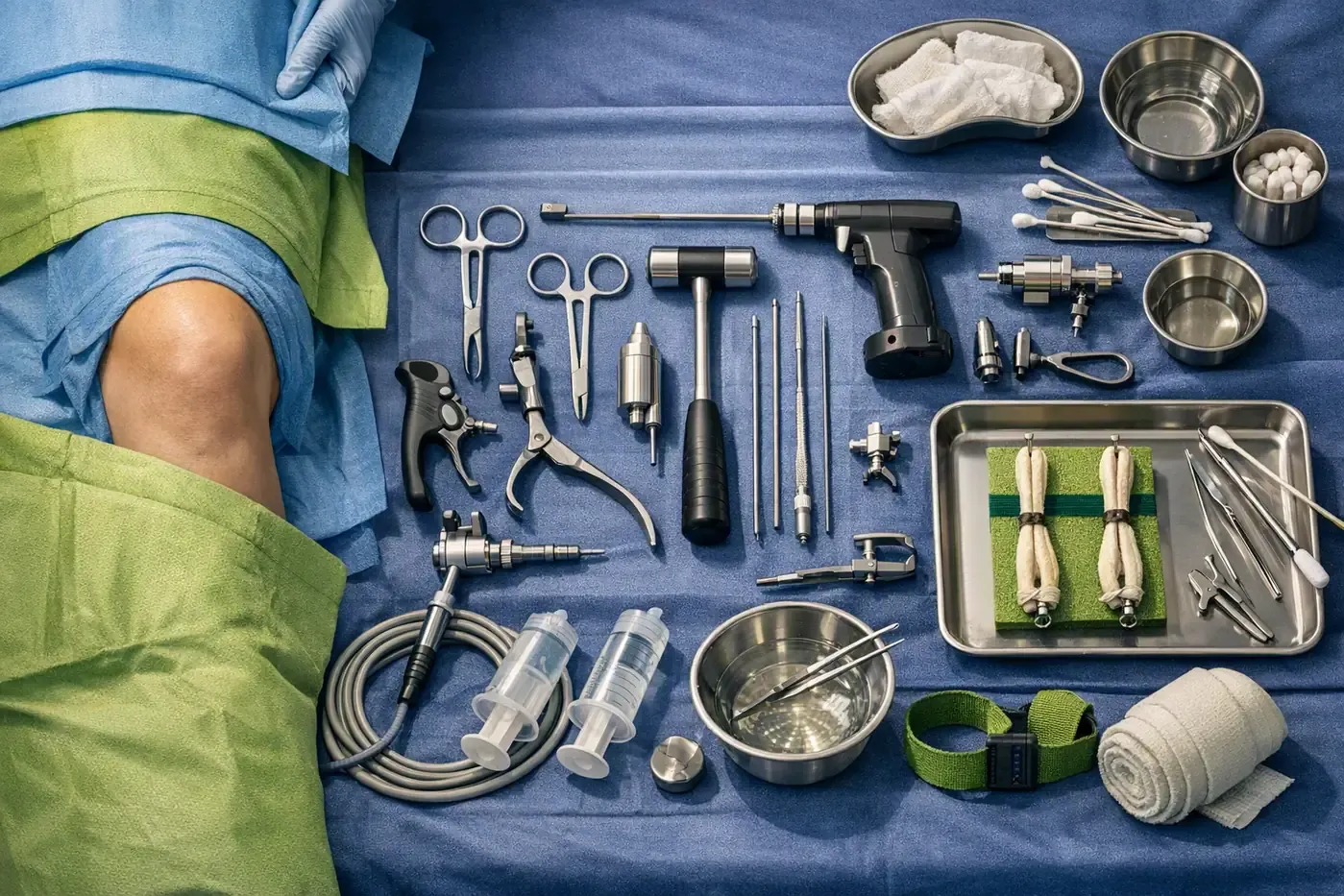
An anterior cruciate ligament is not stitched back together in routine practice. It is replaced. The surgeon takes a piece of tendon, either from your own knee or from a donor, threads it through a tunnel drilled in the tibia and a tunnel drilled in the femur, and fixes it at both ends so it runs along the path the original ligament took. The knee is stable in the operating room because the graft is mechanically fixed, not because anything has healed. Healing takes the rest of the year, and it is the reason the rehabilitation calendar looks nothing like the pain calendar.
The graft is strongest on day one
A fresh graft is at its mechanical peak the moment it is fixed. It then loses strength for weeks while the body remodels it, before slowly regaining it. That dip is invisible, it is painless, and it is the single best argument for following the loading progression rather than how the knee feels.
Before the day
- Prehabilitation. Going in with a straight knee, a quadriceps that fires and a joint that is not swollen changes the outcome, not just the first week. In the comparison of the MOON and Delaware-Oslo cohorts, 72% of patients who did extended preoperative rehabilitation returned to their preinjury sport against 63%, with better scores at two years. That is covered on the prehab page.
- Prior authorization. Surgery, facility, anesthesia and the physical therapy that follows are authorized separately. Confirming that all four are in network is a phone call now and an appeal later.
- The pre-op call. Nothing to eat after midnight in most protocols, a ride home arranged, and a clear answer about which medications you keep taking.
- The house. Crutches sized, ice ready, a chair in the shower, a spot to sleep where the leg can stay elevated. It sounds trivial until you are doing it on one leg at eleven at night.
Anesthesia and the nerve block
Most ACL reconstructions in the United States are done under general anesthesia, often combined with a regional nerve block that numbs the front of the thigh for a day or so. The block is why the first evening is frequently comfortable and the first night is not: as it wears off, pain arrives suddenly, usually somewhere between eight and twenty-four hours after surgery. Taking the prescribed medication before the block fades, rather than after, is the difference between a manageable night and a bad one.
A femoral or adductor canal block also temporarily weakens the quadriceps. A leg that will not hold you on the first evening is expected. It is not a sign that anything went wrong, and it is the reason you use both crutches on the way to the bathroom instead of testing the knee.
What the surgeon does, in order
Arthroscopy first
Two or three small portals, a camera, and a look at the whole joint. This is where the meniscus and the cartilage are assessed properly, which is often more consequential than the ACL itself.
The graft is harvested
Patellar tendon, hamstring or quadriceps tendon from your own knee, or a donor graft. Each has a different cost to you in the first months, which is the subject of the graft page.
The meniscus is dealt with
Repaired, trimmed or left alone. A repair is stitched and needs protecting, which changes your weight bearing and your range of motion limits for weeks.
The tunnels are drilled
One in the tibia, one in the femur, positioned to reproduce the original ligament's line. Tunnel position is one of the few technical details that clearly affects the result.
The graft is passed and fixed
Screws, buttons or a combination, depending on the graft and the surgeon. The knee is then taken through its range to check that the graft does not impinge and that full extension is available.
Closure and dressing
Portals closed, a bulky dressing, sometimes a brace. Most people are in the operating room for one to two hours and go home the same day.
The meniscus is what changes your first six weeks
Two people can have the same ACL graft and completely different instructions, and the reason is almost always the meniscus. A meniscus repair typically means restricted weight bearing, a limit on flexion, and no deep squatting for a period the surgeon sets. It is worth protecting: meniscus loss matters over decades, and knee injury raises the risk of osteoarthritis four to six fold in the long term.
| Finding | Typical consequence | What to ask |
|---|---|---|
| ACL reconstruction alone | Weight bearing as tolerated, full extension worked from day one | When can I drive, and when do the crutches go |
| Meniscus repair | Restricted weight bearing and a flexion limit for several weeks | Exactly how many degrees, for how many weeks, and with or without a brace |
| Partial meniscectomy | Few mechanical restrictions, but a joint with less shock absorption for life | How much was removed, and from which horn |
| Cartilage lesion treated | Often the strictest protocol of the four, set by the cartilage rather than the graft | Which protocol applies, and who is coordinating it with my therapist |
Waking up, and the first night
You wake in recovery with a bandaged knee, a leg that feels absent, and a nurse asking about pain and nausea. Before you are discharged, three things are worth writing down rather than remembering: the weight bearing instruction, the brace instruction, and the date of the first physical therapy appointment. People routinely leave with all three explained and none of them retained, which is normal after anesthesia.
At home the first night, the leg stays elevated above the heart, ice goes on for twenty minutes at a time, and the quadriceps gets asked to contract gently every hour you are awake. That last one is not busy work. The quadriceps switches off after surgery and the speed at which it comes back is one of the strongest available predictors of how the whole year goes.
The operative report is yours, and you should read it
Ask for the operative report and the arthroscopy images at the first follow-up. The report names the graft, the fixation, the tunnel positions and exactly what was found and done to the meniscus and cartilage. Your physical therapist will read it differently than you do, and it answers questions that come up in month four, when nobody remembers the detail and the knee is complaining about something.
What can go wrong, and what is watched for
- A knee that will not straighten. Loss of extension is the complication that is most preventable and most damaging if it is allowed to settle. It is why extension work starts on day one and is checked at every visit.
- Persistent effusion. A joint that keeps refilling after sessions is telling you the load is ahead of the tissue. It is a signal to adjust, not to push.
- Infection. Rare, but fever, spreading redness, increasing pain after day three or discharge from a portal is a same-day phone call, not a wait-and-see.
- Calf pain and swelling. Also a same-day call. Blood clots after knee surgery are uncommon and taken seriously.
- Graft rupture. The risk is concentrated in young athletes returning to pivoting sport. In a meta-analysis, 23% of patients under 25 who returned to sport sustained a second ACL injury, and both graft choice and readiness at return are involved.
What the operation does not do
It restores mechanical stability. It does not restore quadriceps strength, it does not restore the sense of where the knee is in space, and it does not restore confidence. Those are earned in rehabilitation, measured rather than assumed, and they are the difference between a stable knee and a knee you trust. The clinical guidelines are unanimous on the point: progression is driven by criteria that are met, not by weeks that have elapsed. Athletes who returned to sport without meeting six discharge criteria had four times the reinjury rate, and the two decision rules that changed outcomes most in the Delaware-Oslo cohort were meeting the criteria and delaying return past nine months.
That is what the rehab protocol is for, and why the numbers on the symmetry calculator matter more than the date on the calendar.