Testing
Return-to-sport testing after ACL reconstruction
The battery your physical therapist runs, what each test measures, the thresholds in common use, and the honest limits of all of it. Including the meta-analysis that found passing was not significantly protective.
Return-to-sport testing exists because the knee stops complaining long before the leg recovers. A quiet knee, full motion and a confident athlete can coexist with a quadriceps 20% weaker than the other side and a landing pattern that dumps load onto the healthy leg. Testing is how that gets found.
There is no single national battery in the United States. What most clinics run is some version of the same six things.
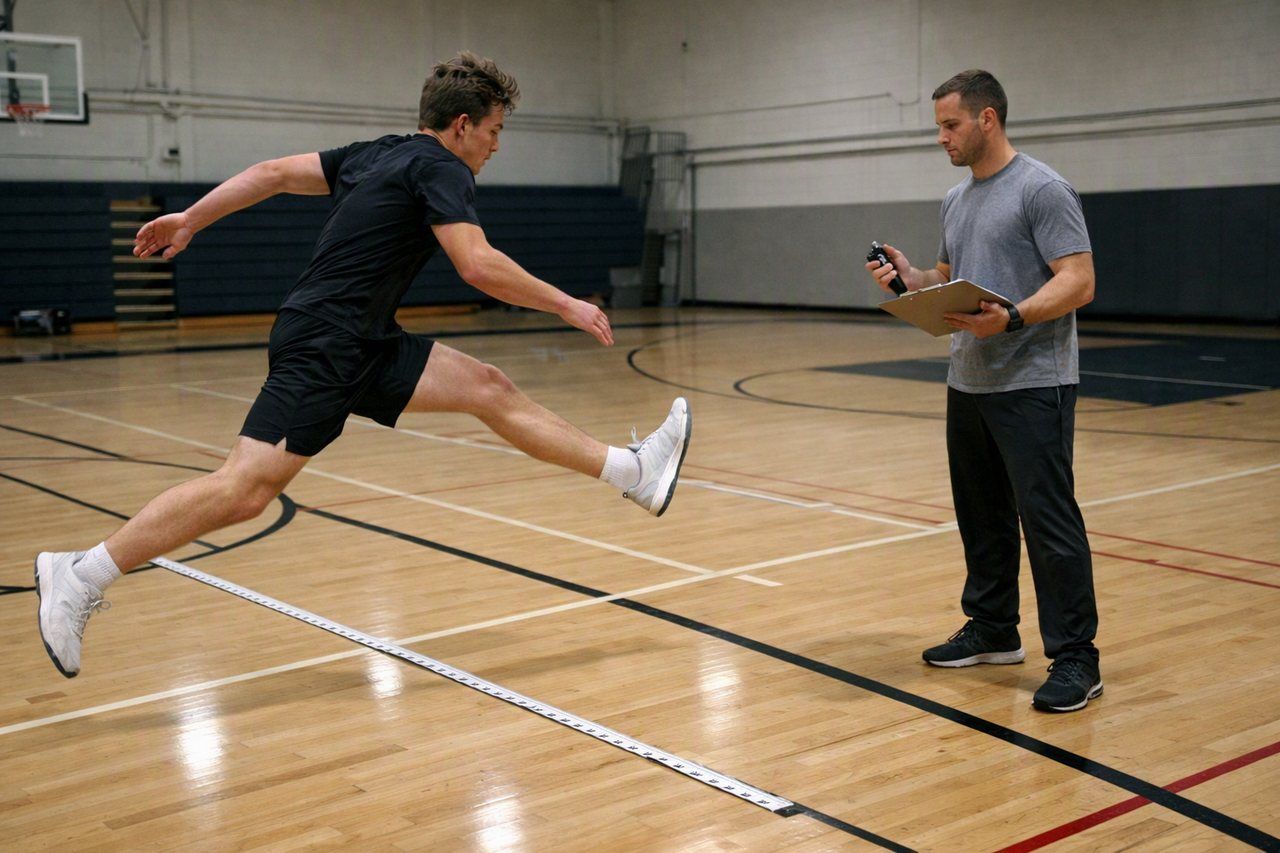
What is in a typical battery
| Test | What it measures | Threshold in common use |
|---|---|---|
| Isokinetic or isometric quadriceps strength | Peak torque of the operated quadriceps against the other leg | Limb symmetry index 90% or better |
| Hamstring strength and H:Q ratio | Posterior chain, and the balance between hamstring and quadriceps | Symmetry 90%+, and a ratio your clinic considers acceptable |
| Single hop for distance | Power and confidence in a single push and landing | 90%+ |
| Triple hop for distance | Repeated power with landings between | 90%+ |
| Crossover hop | Power with a lateral component | 90%+ |
| Six-meter timed hop | Speed of repeated single-leg loading | 90%+ |
| Stroke test for effusion | Fluid in the joint, graded zero to 3+ | Zero |
| Range of motion | Extension against the other side, full flexion | Symmetrical |
| ACL-RSI questionnaire | Confidence, fear of re-injury, risk appraisal | See below |
| Movement quality on landing | Whether the operated leg absorbs its share, by eye or on video | No visible asymmetry |
Why 90% and not 100%
Because limb symmetry of 100% is uncommon even in uninjured athletes, and because 90% is where the cohorts that reported outcomes drew their line. It is a convention with data behind it, not a biological constant.
What passing is associated with
In the Delaware-Oslo cohort of 106 pivoting-sport athletes, 38.2% of those who failed the return-to-sport criteria were reinjured, against 5.6% of those who passed (hazard ratio 0.16, p=0.075). In 158 male professional athletes, not meeting all six discharge criteria before returning to team training carried a hazard ratio of 4.1 (95% CI 1.9 to 9.2) for graft rupture. In the pooled data on returning to preinjury level, symmetrical hopping performance and a positive psychological response were both favourable factors.
What passing is not
A 2019 systematic review with meta-analysis pooled four studies and found that 42.7% of patients passed their return-to-sport criteria, that 14.4% of those who passed still sustained a second ACL injury, and that the pooled risk difference for passing was -3% and not statistically significant (95% CI -16% to 10%), at very low quality of evidence.
That result is on this page on purpose. Any site that quotes the 5.6% versus 38.2% figure and hides this one is selling you certainty that does not exist. Two other findings point the same way: in a Swedish registry cohort of 159 athletes, symmetrical muscle function and quadriceps strength at return were not associated with a second injury, and in a cohort of high-level female athletes, the ones who got hurt again had higher psychological readiness scores and met criteria sooner.
How to hold both of those at once
Failing the battery is a measured deficit, and deficits are worth fixing whatever the pooled hazard ratio says. Passing the battery is not a clearance certificate. The battery tells you where you are. Time since surgery, sport, age and exposure tell you what that position costs.
The psychological test people skip
The ACL Return to Sport after Injury scale is twelve questions on confidence, fear of re-injury and risk appraisal, and it takes two minutes. In 329 patients who returned to sport, 52 (16%) sustained a second ACL injury, and among patients aged 20 or younger, those who were reinjured had significantly lower readiness at 12 months (60.8 versus 71.5 points). In that younger group a cut-off of 76.7 points identified 90% of those who went on to a second injury. No difference was found in older patients, which is why a single all-ages cut-off is not something we will print.
The change over time may matter more than any single score. In 115 younger patients, the group that got reinjured barely moved between surgery and 12 months (58.5 to 60.8 points) while the uninjured group improved by 24.9 points on average against 9.2. Score it twice, and compare it to your own last score.
How to get tested if nobody offers
Plenty of American patients are discharged from physical therapy at three or four months with a home program and never see a formal battery. If that is you:
- Ask directly: what were my last measured quadriceps and hamstring numbers, in what units, on what device? If the answer is a shrug, nothing has been measured.
- Ask whether the clinic has a dynamometer, isokinetic or handheld. Many do and reserve it for athletes who ask.
- Hop tests need a tape measure, a stopwatch and floor space. Any clinic can run them.
- Score the ACL-RSI yourself and bring it. It is a questionnaire, not a device.
- Take video of your own landings from the front. Asymmetry is often visible at normal speed and obvious in slow motion.
- Bring the readiness check summary to the appointment so the conversation starts from criteria rather than from how you feel.
Retest, do not test once
A single battery at month six is a snapshot with a lot riding on it. Two or three runs, at months five, seven and nine, show you a direction. A gap that is closing at 3% a month is a different situation from a gap that has not moved since month four, even when the two produce the same score today.